FUT Strip Hair Transplant
An estimated 53% of men and 37% of women will experience baldness by age 65. As we age, hair thinning and pattern baldness are natural, though they can impact both our appearance and self-esteem. If you’re looking to regain your confidence with a fuller head of hair, consider follicular unit transplantation (FUT).
FUT is an efficient, time-tested hair restoration method ideal for patients seeking the maximum number of grafts in one session. It’s important to understand the procedure, recovery timeline, benefits and trade-offs before committing to treatment. This comprehensive guide outlines everything you need to know to help determine if this procedure is right for you.
At the Hair Restoration Center, FUT is one of our most popular hair transplant options for achieving a natural, confidence-boosting look. Schedule an appointment today to find a lasting, personalized solution.
What Is an FUT Strip Hair Transplant?
FUT is a procedure that involves taking a narrow strip of healthy hair-bearing tissue, dissecting it into individual follicular groupings and using them as grafts. These follicles are implanted into areas experiencing thinning or loss.
Benefits of an FUT Hair Transplant
An FUT strip hair transplant offers several unique benefits, including:
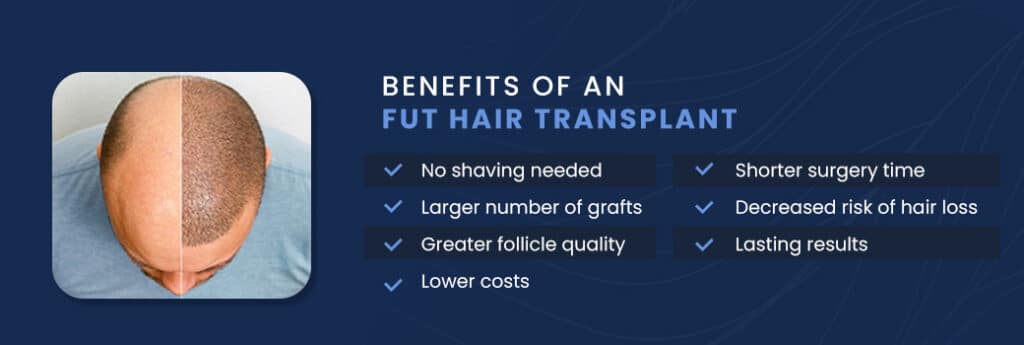
- No shaving needed: You don’t need to shave any parts of your head, so surrounding hair can hide the linear donor area while it heals.
- Larger number of grafts: Because they are working with a full strip of tissue, surgeons can harvest a substantial number of grafts in one sitting.
- Greater follicle quality: Your surgeon dissects the grafts under a microscope, helping maintain follicle strength and minimize the risk of root damage.
- Lower costs: In many cases, FUT is cheaper than FUE. This is because strip extraction often takes less time and precision than individual extractions.
- Shorter surgery time: The procedure is typically quicker and more efficient, meaning you spend less time in the surgical chair.
- Decreased risk of hair loss: Unlike FUE, there isn’t much risk of overharvesting the donor area with FUT. These follicles also aren’t affected by genetic DHT-driven hair loss, leading to a lower risk of hair loss through grafting.
- Lasting results: When performed by an experienced surgical team, FUT generally offers long-lasting, completely natural-looking results.
How the FUT Strip Transplant Procedure Works
FUT is a carefully sequenced, outpatient procedure performed under local anesthesia. At the Hair Restoration Center, our straightforward process includes:
1. Initial Consultation
During your initial consultation, you will meet with your provider and work with them to establish a personalized treatment plan. This highly trained, board-certified surgeon will evaluate your donor area density, scalp laxity and hair loss stage using the Norwood scale. These factors help determine how wide a donor strip can safely be removed.
This is where you’ll want to discuss any questions you have. For instance, you may have concerns about graft goals, donor-area expectations, recovery timeline, scar placement, hairline design or whether FUT or FUE is better for you.
The consultation provides a fully customized treatment plan, including realistic expectations for coverage. Afterward, you can expect to walk away feeling confident in your personalized plan and what your results will look like.
2. Preparation and Donor Harvesting
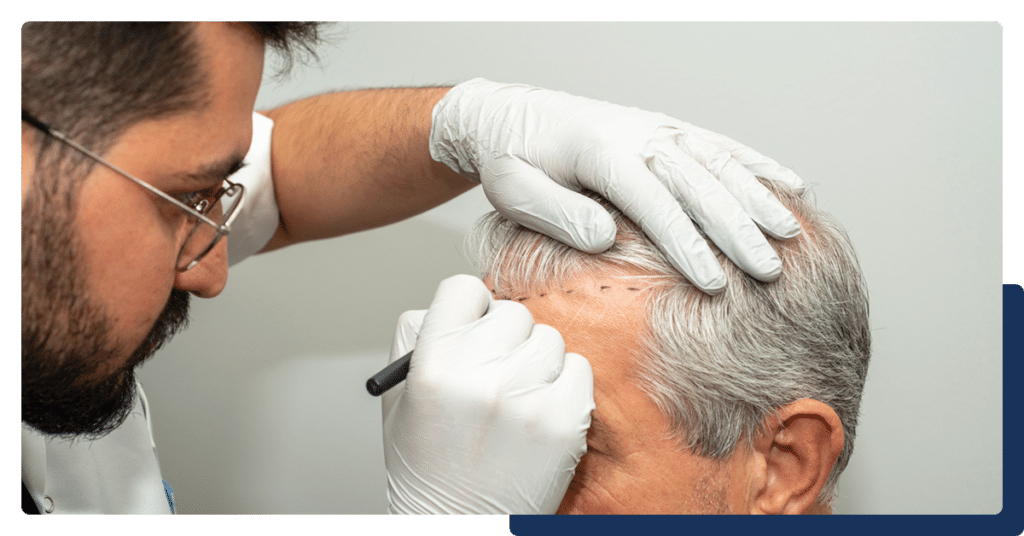
On the day of your procedure, your surgeon will administer a local anesthetic at the back of your scalp to ensure a comfortable experience. They will mark a narrow strip of hair-bearing skin from the back or sides of your head — specifically because these follicles are genetically resistant to hair loss.
The strip can range from 0.5 to 1.5 cm wide and from 5 to 30 cm long, depending on the number of grafts needed. Your scalp laxity is a primary factor in determining how wide a strip can be removed without creating excess tension at closure. Once you’re ready, your surgeon will remove the strip of hair follicles from the agreed-upon donor area and immediately close the incision with sutures or staples.
3. Follicular Unit Dissection
Once the strip is removed, it’s passed under a microscope to minimize transection (accidental cutting of follicles during harvesting). At this point, the surgeon will carefully separate the strip into small follicular units.
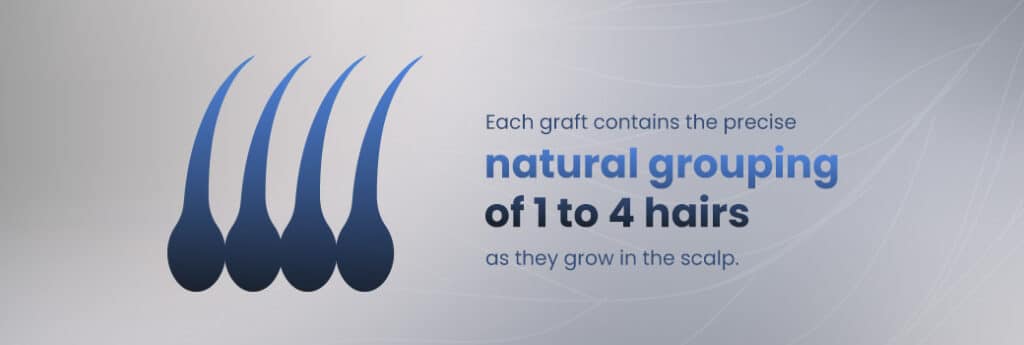
This step is what makes FUT distinct from older plug techniques. Each graft contains the precise natural grouping of 1 to 4 hairs as they grow in the scalp. The level of precision is what makes FUT results look so natural. Grafts are then kept in a sterile holding solution to maintain viability until placement.
4. Graft Placement
During this step, your surgeon creates very small recipient sites — tiny incisions angled to mirror the natural direction and angle of your existing hair. Artistic skill and surgical precision meet during graft placement. The hairline design is custom-drawn based on your face shape, age and goals.
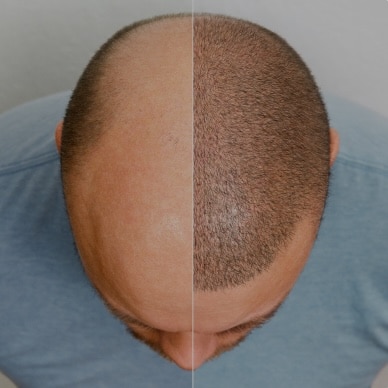
The surgeon will insert the grafts into tiny, angulated incisions along your hairline and scalp. At the Hair Restoration Center, our skilled team aims to create a seamless, natural hairline you can feel confident about. Browse our before-and-after transplant gallery to see what natural results look like after placement.
5. Aftercare and Recovery
Once harvesting and graft placement are complete, the surgeon closes the donor site using a trichophytic closure. This specialized suturing technique allows existing hairs to grow through the scar line, helping camouflage it over time. These sutures are typically removed at the 8-10 day mark.
Because FUT is an outpatient procedure, you will return home the same day with a detailed aftercare plan. You may experience some pain or discomfort around the closure site for about a week.
You can typically shower a few days after the procedure, though you’ll want to avoid towel-drying movements that could harm the sutures for up to 14 days afterward. Maintain a clean, dry incision site and avoid stretching your neck for several weeks after the transplant.
Frequently Asked Questions About FUT Strip Hair Transplants
You may still have questions about the procedure and recovery process. Here are answers to the questions we hear most often from patients considering FUT.
During FUT, a surgeon removes a thin piece of hair-bearing scalp from the donor site (usually at the back of your head), dissects it into small follicular units and then implants these units into tiny incisions in areas experiencing hair loss. Then, the surgeon closes the donor area with sutures or staples.
While candidacy is best determined during a personal consultation, FUT may be a good fit for patients who:
- Have hair long enough to cover a linear scar.
- Maintain a healthy donor area and realistic treatment goals.
- Experience moderate to advanced hair loss.
- Want to address hair loss quickly, efficiently and affordably.
- Prefer to maximize graft count in a single procedure session.
- Have adequate scalp laxity, meaning the scalp moves freely when pressed.
- Have enough donor-area density to support strip harvesting.
- Have had a stable hair loss pattern in recent years.
- Are generally in good health, with no clotting disorders, active scalp conditions or history of keloid scarring.
Ultimately, FUT is suitable for many men and women seeking a long-term solution for thinning or balding spots. Patients with very short hairstyles, limited scalp laxity, active scalp conditions, unrealistic expectations or a preference for less visible donor scarring may be better suited for FUE or another hair growth treatment.
FUT removes a strip, while FUE removes individual follicles one at a time. The key differences include:
- Scarring: FUT produces a linear scar, while FUE produces multiple tiny dot scars.
- Graft yield per session: Because it uses a strip of tissue, FUT yields a significantly larger graft volume.
- Shaving requirements: Unlike FUT, FUE may require you to shave parts of your head.
- Recovery: FUE recovery is generally more comfortable, but FUT offers a concealed donor area during this stage.
- Cost: In many cases, FUT surgery can cost less than FUE because it requires less surgical labor.
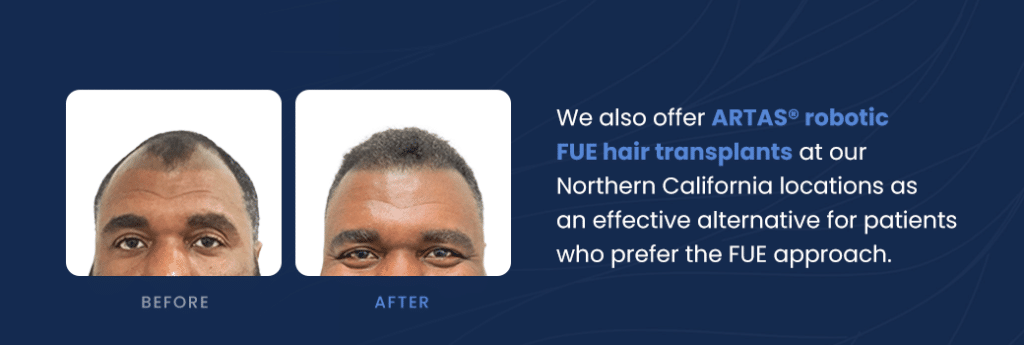
FUT is often preferred for patients who need higher graft counts or don’t need to keep their hair very short. We also offer ARTAS® robotic FUE hair transplants at our Northern California locations as an effective alternative for patients who prefer the FUE approach.
FUT procedure time varies based on the number of grafts required. For reference, a typical hair transplant takes several hours. The procedure is performed under local anesthesia, so you can expect to be awake and comfortable.
FUT is an outpatient procedure, so you can return home the same day as your appointment.
You may experience some mild discomfort for the first few days, but it’s typically manageable with over-the-counter pain medication. Your surgeon will provide specific pain management recommendations.
FUT results can be very natural-looking and indistinguishable from native hair when performed by experienced surgeons. You and your surgeon will customize your hairline to your face shape, natural hair characteristics and other factors. Because the procedure uses naturally occurring follicular units and careful angle placement, your new hair blends seamlessly with your existing hair.
Yes, FUT typically leaves a linear scar at the donor area, though longer hair can help conceal it and it may fade a little with time. Some patients get scar correction treatment to minimize its appearance.
You’ll typically notice new hair growth starting at 3-4 months, with more noticeable results at 6-12 months. Your hair continues to thicken and improve over time, with final results often visible within about a year. Here’s what you can expect at each stage:
Months 10-12: By this point, the full transplant results should become visible. Your hair may look fuller and feel more natural at this stage.
Days 1-7: In the week after surgery, you may experience mild discomfort and will likely still have bandages on the donor area.
Weeks 2-4: Your transplanted hair may shed (known as shock loss). This is completely normal and does not indicate failure — the follicle remains intact beneath the skin. While this can feel alarming, it simply means the follicles are entering the next growth cycle.
Months 3-4: New hair growth will begin to emerge from the implanted follicles. It may appear uneven or patchy at first, but it’s a sign that your hair is growing in as it should.
Months 6-9: You can expect significant, noticeable improvement in coverage and density. Your new hair will begin to resemble your natural texture, making it easier to style and blend with your existing hair.
Why Choose the Hair Restoration Center?
Patients trust the Hair Restoration Center because of our commitment to individual needs and goals. Our board-certified surgeons offer decades of expertise, specialized training, advanced robotic technology and customized treatment plans to support you in your hair growth journey.
We proudly provide you with:
- Results you can be confident in: Your hair pattern is unique, and it demands a unique treatment plan, too. We tailor our procedure to your face shape, hairline and personal preferences to ensure lasting, natural-looking results that restore your confidence.
- Experienced professionals: Our providers have years of experience with using advanced hair replacement technology. We are here to ease your concerns and support you through every step of your treatment.
- Transparent pricing: We prioritize transparent pricing and offer financing plans to help you achieve your goals on nearly any budget.
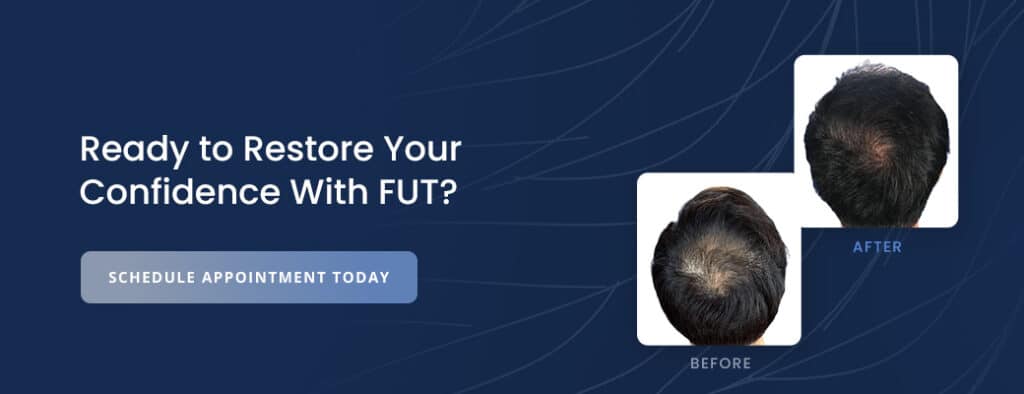
FUT is a reliable, efficient hair transplant option for maximizing hair growth. The Hair Restoration Center provides honest, expert evaluation to help you decide which route is best for you.
Our highly trained surgeons, Dr. Aaron Chen and Dr. Timothy Jochen, are here to guide you through the transplant process with a personalized consultation. We’ll build a treatment plan around your specific hair loss stage, scalp laxity, donor density and long-term goals.
The Hair Restoration Center serves patients across Northern and Southern California. Our team also offers flexible financing options, including Cherry Technologies and 0% APR options, to help you achieve your goals affordably.
If you experience moderate to advanced hair loss and want to address it quickly, the Hair Restoration Center can start your FUT journey today. Schedule your first consultation online and let our staff create a plan to help you feel like your most confident self.